
A government of our own is our natural right; and when a man seriously reflects on the precariousness of human affairs, he will become convinced, that it is infinitely wiser and safer, to form a constitution of our own in a cool deliberate manner, while we have it in our power, than to trust such an interesting event to time and chance.
— Common Sense, Thomas Paine
In January 1776, Thomas Paine’s Common Sense was published helping colonists find Common Ground to declare independence from Great Britain and to establish a constitution promoting the Common Good for all people.
250 years later in 2026, there are three overarching questions: Do we Americans have Common Sense? Can we find Common Ground? Can we work together to restore the Common Good? We address those questions at the end of this blog. Before we do, however, let us reflect on the groundbreaking nature of Common Sense and its author Thomas Paine in 1776.
Thomas Paine was one of the founding fathers of this nation. Unlike other founders such as George Washington, Thomas Jefferson, and Benjamin Franklin, who went on to earn fame and to be recognized in American history, Paine has not been celebrated nearly as much.
This is unfortunate, because his work, Common Sense, played a pivotal role in the establishment of this country. It brought commoners together in the run-up to the signing of the Declaration of Independence and the official launching of the American Revolution. It also presented a compelling argument for the drafting of a constitution of their own, rather than having one imposed upon them.
Common Sense was issued as a 47-page pamphlet. That pamphlet was distributed far and wide throughout the colonies.
Joseph Rezek, associate professor of English and the director of American studies at Boston University, provides an excellent analysis of the history and content of Common Sense in his New York Times essay.
In his essay, Rezek notes that after it was released in January, 1776:
Common Sense went on to become an extraordinary best seller and arguably the most important pamphlet in American history. Paine claimed that 120,000 copies were sold in three months. A meticulous estimate by the literary historian Trish Loughran puts the number at no more than 75,000 within a year, among a population of three million people.
Rezek proceeds to observe, “Paine was successful partly because the style of his writing was as revolutionary as his ideas.” His style centered on the ability to translate previously abstract and philosophical thoughts, written by political philosophers such as John Locke, “into succinct, strident and deceptively simple sentences that everyday readers could understand.”
Rezek cites the following example of Paine’s ability to reach those “every day readers:”
“Let us suppose a small number of persons settled in some sequestered part of the earth” in a “state of natural liberty,” Paine wrote, sounding like a schoolteacher. Then kings arrive, like snakes in the garden. “Mankind being originally equals,” Paine went on, their “equality could only be destroyed by some subsequent circumstance.”
Rezek also comments that “Common Sense” issued a powerful call for mutual care and fellow feeling across radical distance and differences.”
Jeffrey Rosen, CEO emeritus of the National Constitution Center, joins Rezek in acknowledging the significant contribution that Common Sense made to this country’s founding. In his Washington Post opinion piece, Rosen writes, “Common Sense” helped turn the tide of public opinion from reconciliation to revolution, “working a powerful change,” as George Washington put it in a letter, “in the Minds of many Men.”
That was then. This is now. And, it brings us back to the three questions posed at the beginning of our blog.
Do we Americans have common sense today?
During the revolutionary period, Benjamin Franklin, one of our founding fathers stated, “Common sense is something that everyone needs, few have, and none think they lack.”
Thomas Paine’s Common Sense pamphlet brought common sense to many instead of the few. It gave the average person insights and a shared perspective on a potential future that would be better for them and their fellow citizens. To borrow a concept from Samuel Taylor Coleridge, together, in 1776, they achieved common sense to an uncommon degree, which the world called wisdom.
Can we achieve that same wisdom in 2026 in an environment in which: personal preferences, misinformation, and disinformation are so prevalent on the social media; AI is being used to steal away authenticity across the board; and, our President, his acolytes, and allies frequently propagate falsehoods and fiction as facts and the truth.
Given the current state of chaos, consternation, and conspiracy theories, one might think not.
But polls, and initiatives of citizens, over the past several months regarding the President and his regime indicate there’s still hope. Many Americans are demonstrating their common sense by expressing disapproval of what is going on, and exercising their rights to protest against the decline of our American democracy.
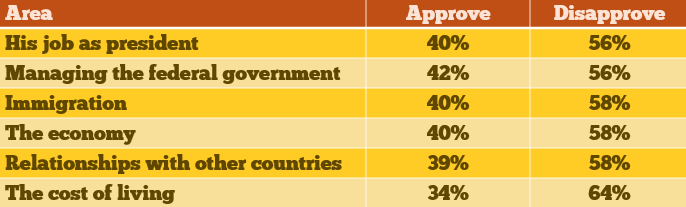
A New York Times/Sienna nationwide poll of registered voters about “the way Trump is handling …” disclosed the following:
As we noted in an earlier blog, “The No Kings protests by millions of citizens last year in June on Donald Trump’s birthday and later in October highlighted the concerns regarding the monarchical behavior of Trump during his second term in office.”
The protests against the militaristic role ICE is playing in deporting immigrants — and the extreme manner in which its agents were behaving — were strong, based upon what happened in Los Angeles and Chicago. The videos showing that the tragic shootings of Renee Good and Alex Pretti in Minneapolis were not necessary, and made no sense, expanded the concern about the use of ICE from a local, activist, or partisan issue to a national one.
The Pretti shooting even caused Republicans to step forward and speak out. Jonathan Lemire and Russell Berman in their Atlantic article report,
That so many in his party felt compelled to speak up after Pretti’s killing was a sign that Republicans had finally lost patience with federal agents occupying a major American city — a deportation operation that has soured the public on one of Trump’s signature policies and sunk the GOP’s standing at the outset of a crucial midterm-election year.
Can we find common ground?
Will this shift in Republican attitude bring we Americans to a kumbaya moment where we can all unite to view things in the same way and sing together in harmony?
Absolutely not. In fact, Trump’s MAGA base is locked in and a majority of Republicans still approve of his performance and that of his administration. They feel this way because he personifies their perspective.
This domination and eliminationist movement is a joint project. To clarify:
It might be assumed that Trump is the person responsible for right-wingers engaging in, and becoming the leaders of, cancel culture. Historian Dr. Nicole Hemmer, in her informative New York Times article, explains that is not the case stating “..the modern right in America emerged as a censorious movement. It took decades for its free-speech faction to develop, and even then, it has only ever been a minority part of the coalition.
Given this reality, it will be impossible to find common ground to be shared by all Americans.
Our democracy’s current devolutionary trajectory, however, has already, and will bring many more of us — with a wide range of political and personal values, attitudes, and beliefs — to find common ground on which we can walk and work together to lift our democracy up. Common ground does not mean we will agree on everything, but that we can unite to address those issues that matter the most to the future of this democratic republic.
It’s disappointing that we, the people can’t all come together in this time of crisis. We should remember that this lack of coherence and cohesiveness is not a recent phenomenon — it dates back to this nation’s founding.
As we discussed in our blog on the Declaration of Independence, the Revolutionary War was not only a war against the British, it was also a civil war, pitting Americans against each other, with approximately as many loyalists faithful to the King and Great Britain as there were patriots looking to severe the ties to a monarchical regime.
We find ourselves in a similar situation today. These are indeed perplexing times. The question becomes: what do those of us who are patriots, who have come together on common ground do now.
There is no single or simple answer to that question. George Packer addresses that in his Atlantic article, “What Should Americans Do Now,” published shortly after the killings of Renee Good and Alex Pretti in Minneapolis, in which he observes
The federal government has never declared itself immune to the law and the Constitution while explicitly denying protection to peaceful opponents, until now. Many Americans who thought they were living under the rule of law feel paralyzed. The vague exhortation to “do something while you still can” creates a sense of urgency but doesn’t provide a plan.
Packer notes that the main actions to date have been legal challenges and protests. And proceeds to state that “Minneapolis is setting an example for the rest of the country: a nameless, leaderless, self-organized movement.”
He suggests that “No Kings or another group could consider organizing and training people in other parts of the country to join the kind of civic action on display in Minneapolis — to move from protest to nonviolent resistance.” After that, he cites work by the late theorist Gene Sharp who, writing in books such as From Dictatorship to Democracy and Waging Nonviolent Struggle, has presented ideas for strategic planning of such actions.
Packer ends his piece as follows, “Trump is taking the country on a path to tyranny. The first obligation for each of us is to see it and name it. The next is to figure out what to do about it.”
Can we work together to restore the common good?
Packer nails it. What is being done is definitely tyranny, which the Cambridge English Dictionary defines as “Government by a ruler or small group of people who have unlimited power over the people in their country or state and use it unfairly and cruelly.”
Tragically, this tyranny is being used to avoid the rule of law and to circumvent the U.S. Constitution and Bill of Rights, which were written by the founding fathers to define, promote, and protect the common good for “we, the people.”
These founding documents provided the framework to put a functional national government in place — to transform the rhetoric in the Declaration of Independence into an operational reality. That government of three branches (legislative, executive, and judicial) was structured to provide an effective system of checks and balances to ensure there was no monarchial or tyrannical rule in the U.S. It was also designed to elevate and ensure the rights of citizens and states were protected.
Unfortunately, as we have described in detail in an earlier blog, this framework is at significant risk under the Trump regime. If it disappears, the common good goes with it.
Recognizing this, the first obligation of concerned citizens who’ve found common ground is to stand up and speak out, factually and legally, to defend the common good. This can be done individually and in groups. It can be done locally, regionally, and nationally.
The important thing is to send the message to those who have the power and influence to change the current direction. This includes concerned citizens, elected officials, business and community leaders. The essential requirement for this messaging is to build a common good coalition committed to eliminating aristocratic and autocratic behavior, and to reconstructing and revitalizing our democracy,
The common good coalition will need to develop a plan to reverse-engineer the damage that has been done in the first year of the Trump administration. Many ideas are being put forward regarding such a plan.
We ourselves provided some thoughts on the content and process for developing such a plan in a blog posted after Trump’s first 100 days in office of his second term as president. Near the end of that blog, we stated:
Even with a well-constructed plan and ardent citizen advocates and supporters, renewing America will not be easy. The plan itself is merely a starting and reference point, to be adjusted and updated based upon the progress made and changing conditions. Success in renewing American requires committed citizens with the principles, patience and persistence to persevere.
Concerned and committed citizens will be central to renewing America, and to restoring the common good, which has been trampled on now for more than a year. We are confident they will be successful, even though their work will be extremely difficult.
We derive that confidence from what we have seen those citizens do already in demonstrating their common sense and discovering common ground. And also because we remember the first line that Thomas Paine wrote, not in Common Sense but in The American Crisis, which was published in December, 1776, during the darkest days of the Revolutionary War.
At that time, after the Continental Army had lost nearly all of the major battles to date, Paine wrote:
These are the times that try men’s souls. The summer soldier and the sunshine patriot will, in this crisis, shrink from their service; but he who stands by it now, deserve the love and thanks of man and woman.
250 years later, we face a different — but equally formidable — crisis. We know that the committed and concerned citizens of today are neither summer soldiers nor sunshine patriots. These men and women will stand and deliver for renewing America and the common good, and will deserve the love and thanks of all Americans.